Our research team has been working hard on one of the questions we hear most often from customers: what are the long-term sales effects of brand spend?
I’m excited about where we’ve gotten. We can now take an existing Recast MMM, add brand awareness and consideration surveys, and estimate how earlier brand spend contributes to baseline sales – both by channel and over time!
That last part is really important. It means that some of the sales an MMM calls “baseline” today may reflect brand investment made months earlier. This research gives us a way to investigate that contribution using another source of information, the brand tracking data that many companies already collect.
Why “Baseline” in MMM is Challenging
An MMM estimates the incremental effects of individual marketing channels, along with an underlying baseline. That baseline can contain a lot of things, including slow-moving effects that are difficult to separate using spend and sales data alone.
Brand investment is a good example. A campaign can generate sales relatively quickly while also changing how many people know about the brand or would consider buying from it. Those changes can persist and contribute to sales much later on.
An MMM can estimate a channel’s impact over days and weeks, but as that effect stretches across months (and in some cases, longer) it becomes harder to distinguish from other changes in underlying demand. This renders many sales or conversions an ambiguous component of a brand’s baseline demand, without a clear estimate of how much earlier brand media spending contributed to them.
The important question here may already be obvious to you. The direct channel-level returns you see in an MMM are useful, but how can we get at the slower contribution these channels have to baseline sales?
Survey data enters the mix
Many companies already track awareness and consideration through recurring surveys. Those surveys contain valuable information about how the brand is changing, even when that change is hard to see in sales data (or whatever KPI you care about most) alone.
Our new research brings those measurements into a separate analysis built on an existing Recast MMM.
In this separate analysis, we model a specific pathway that looks like this: brand spend influences awareness, awareness influences consideration, and consideration influences baseline sales. We allow effects at each stage to carry into later weeks, so we can estimate how earlier brand spend continues contributing to sales over time.

The surveys help us estimate how awareness and consideration change over time. Each survey is an imperfect measurement, so the model accounts for that noise rather than taking every reading at face value. It can handle missing survey periods, too, though gaps give it less information to work with.
The analysis then builds on what the Recast MMM has already estimated, including baseline sales, contextual effects, and channel-specific saturation curves. Those results stay unchanged. We use them, together with the surveys, to estimate each included brand channel’s longer-term contribution to baseline sales. We also leave room for other things to influence baseline sales, so we don’t credit brand spend for every change.
What Recast can reliably estimate
The main result of this analysis is an estimate of how much baseline sales each dollar of brand spend generates, broken out by channel. So if we’re modeling revenue, that means dollars of revenue per dollar spent. If we’re modeling orders, it’s orders per dollar.
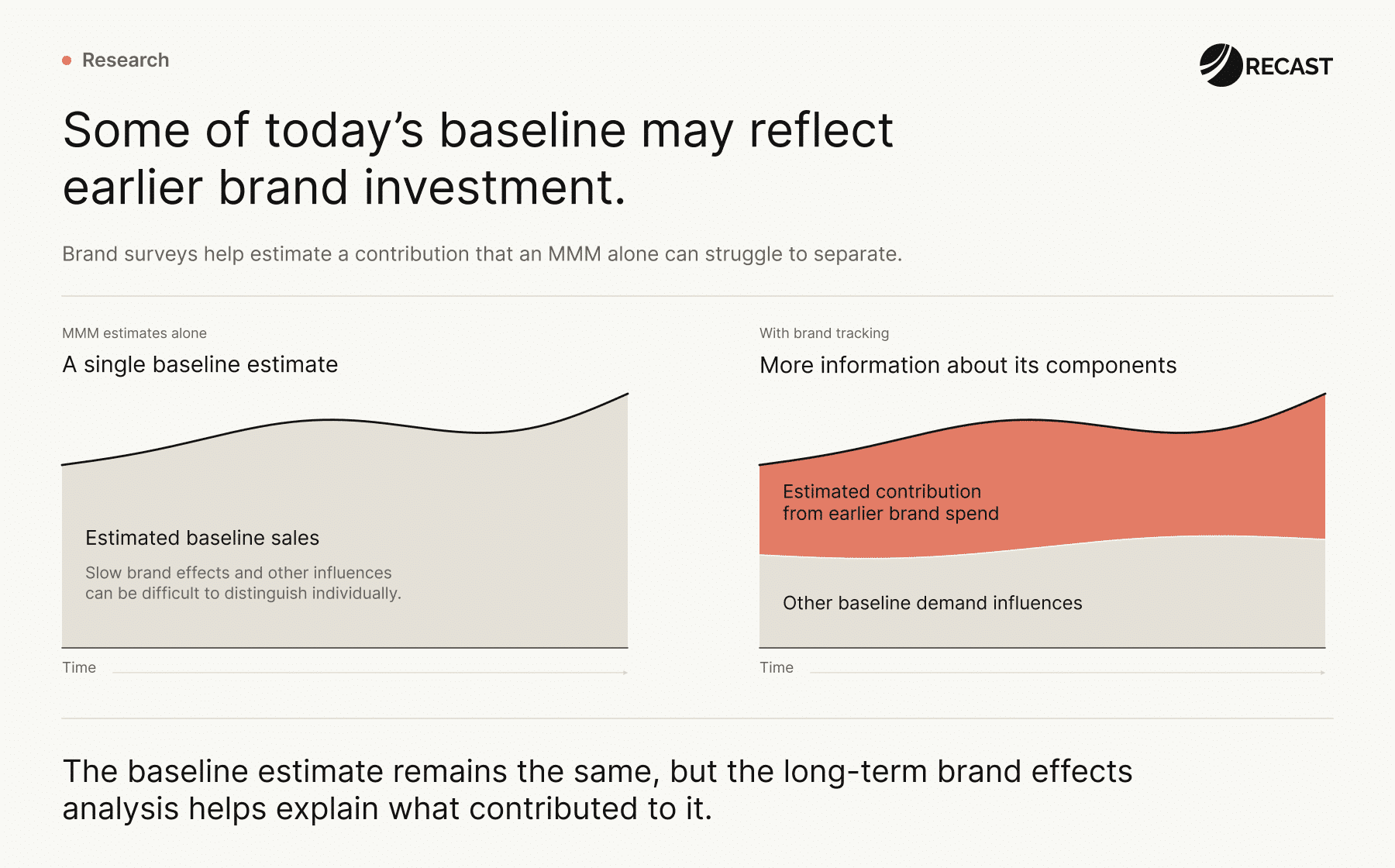
We can also estimate when those sales arrive. How much of the return shows up within four weeks? How much takes twenty? That lets us describe both the magnitude of the longer-term effect and how long it takes to build.
We can also look at it from the other direction, too. We can take a particular week and estimate how much of its baseline sales came from earlier brand spending, as some of that contribution may come from spending months before.
Of course, we report the uncertainty around all of these estimates. That matters as we want to understand how much support there is for a result before using it to make a budget decision.
How we check these analyses
This is a difficult estimation problem. Brand effects move slowly, surveys are noisy, and the baseline is itself an estimate from another model.
We check these analyses the same way we check Recast MMM: using simulated data where we already know the answer, and seeing how close the analysis gets.
Those checks tell us how the method behaves under the conditions we simulate. For each business, we still need to check whether the assumptions make sense, how well the analysis fits the data, and how much confidence to put in the results.
What this means for Recast customers
What excites me is that we’re connecting two things that have often been measured separately – changes in the brand and changes in underlying sales. Bringing them together gives us a way to estimate how earlier brand investment contributes to the baseline.
This currently runs as a separate analysis after an existing Recast MMM. Alongside the MMM’s results, we need awareness and consideration survey data. A longer, more consistent, more frequent survey history generally gives us more to work with.
If you’re a Recast customer with brand tracking data, reach out to your Recast team about the research and what an analysis would involve for your business.