
Recast’s research team developed a proprietary method that accounts for a paid media channel’s changing footprint in your MMM. It corrects a blind spot that leads standard models to mistake a growing addressable market for a saturating market.
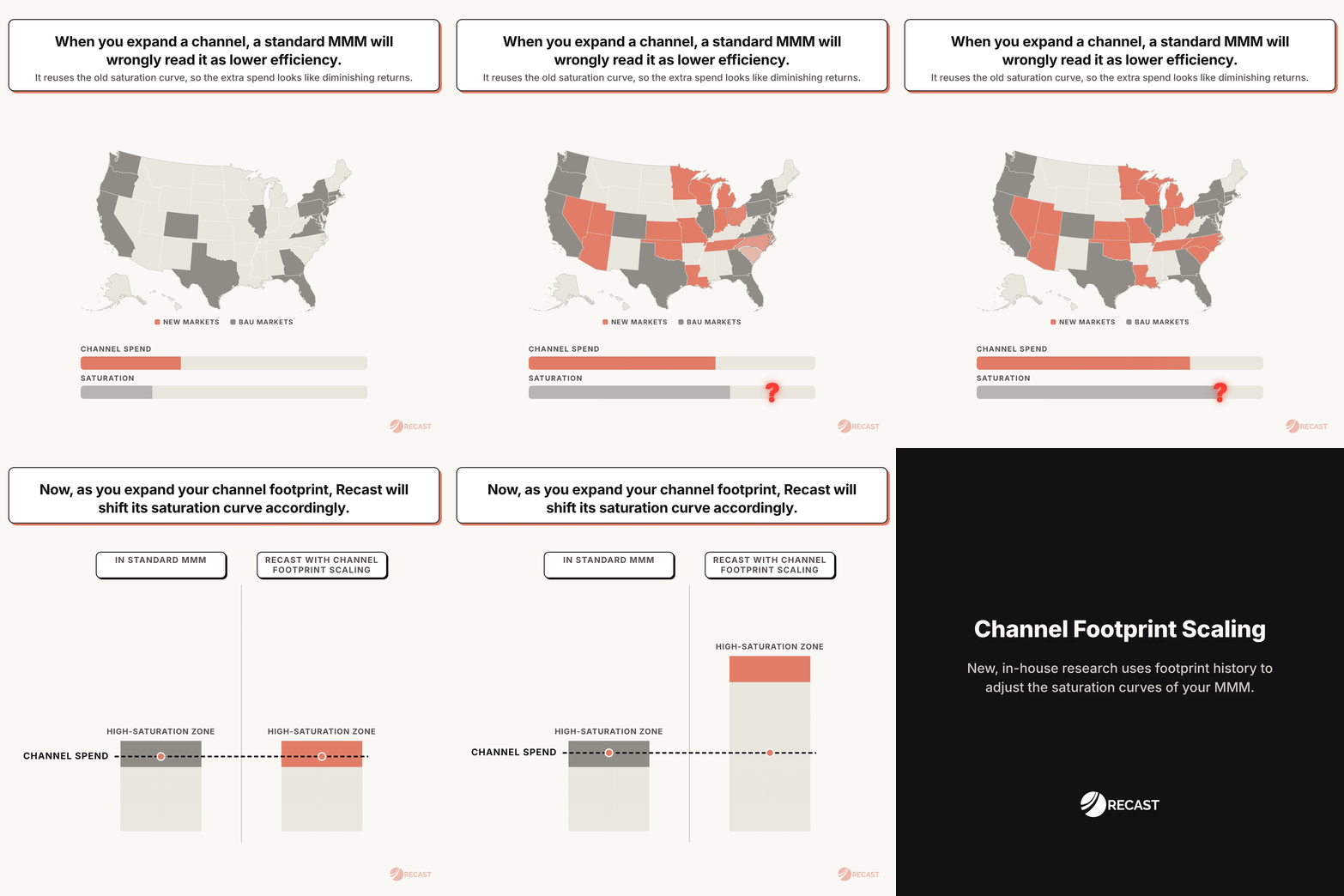
Say you run paid search in 30% of the country, then expand it to 60%. Spend rises and sales will usually rise with it. But a standard MMM has no way to know the channel’s ceiling just got bigger – it only sees more spend chasing the supposedly same fixed ceiling estimated for the “saturation curve”, which looks like a channel running into diminishing returns. So it undercounts the channel’s actual efficiency.
That same blind spot works in reverse. If a channel’s footprint shrinks – say a market exit or a paused region – a standard MMM continues assuming the old, larger ceiling. Spend appears to have more room to run than it actually does, so the model overstates the channel’s efficiency.
This presents a planning challenge for clients who rely on MMMs to make decisions regarding ROI, forecasting, and budget allocation. A team could pull budget from an expanding channel because the model reads it as saturating, when in fact it just needs to reclaim credit for its bigger footprint. Or keep funding a contracting channel because the model hasn’t caught on to the fact that its ceiling has shrunk.
To address this challenge, Recast can now account for known changes in a channel’s market coverage over time (its “footprint”) so the model’s saturation ceiling moves with the channel’s real addressable market, rather than remaining fixed.
What Channel Footprint Scaling does
When a channel’s footprint changes — whether it expands reach to a broader market or contracts to a smaller one — Recast can include the channel’s coverage history in the model setup itself. That history tells the model which channel changed its footprint, when the change happened, and how much of the addressable market the channel could reach before and after the change.
Recast can handle one expanded channel or several expanded channels in the same model (i.e., each channel can have its own coverage history). That history applies across the full modeling timeline, and the last known coverage level carries into future forecast periods.
The result is more business-aware measurement that helps Recast distinguish between two explanations: sales increased because the channel reached more people, or because the channel performed better.
When teams should use Channel Footprint Scaling
There are three common cases where this feature is useful, although more exist:
- A regional channel becomes national. When a channel starts with a small footprint and later expands, treating its reach as constant over the entire period biases the results, making the channel appear more favorable than it actually was.
- A brand expands into new states, regions, or countries. Country launches, regional rollouts, and market-entry moments can change what a channel is capable of, even if the channel’s underlying efficiency remains the same.
- A channel becomes available to a larger share of the addressable market. Paid search, retail media, TV, out-of-home, marketplaces, and other channels can all begin with constrained reach and expand later.
Channel Footprint Scaling is most relevant when three conditions hold: the customer is already building or refreshing a Recast MMM, the channel’s reach changed during the model’s historical period, and the change was large enough to affect measurement. The feature requires a known coverage history, since Recast does not automatically infer that a channel expanded.
Getting started
Channel Footprint Scaling reflects how we build measurement at Recast. The model should represent the real world (and be useful for it).
If you think it’s a good fit for your model, reach out to your Recast team to discuss incorporating it into future refreshes.